I often get asked whether it's better for a business to launder microfiber cloths and mops in‑house or to outsource to a third‑party service. Over the years at Bluebaycleaning Co I’ve run several practical trials to answer that exact question. Below I lay out a step‑by‑step protocol I use to validate in‑house microfiber laundering vs third‑party services, assessing three core metrics: cost, longevity and contamination risk. This is a hands‑on, repeatable process you can run in your own operation and tailor to your budget and compliance needs.
Why this matters
Microfiber is a key consumable: it delivers cleaning performance, reduces chemical use and affects staff productivity. But it’s also a recurring expense and—if handled poorly—a potential vector for cross‑contamination. Choosing the right laundering model impacts your bottom line, health & safety compliance, and sustainability targets. I’ll walk through the tests, data points and practical controls I use to make an evidence‑based decision.
Overview of the protocol
The protocol has four phases: planning & baseline, pilot laundering (in‑house vs third‑party), performance & contamination testing, and financial analysis. You should allow 8–12 weeks to collect robust data (shorter pilots are possible but less reliable).
Phase 1 — Plan and establish baseline
Before you touch a washer, set the scope and baseline so comparisons are fair.
Identify cloth types and quantities: e.g., 400 300x300mm general‑purpose cloths, 200 microfibre mop heads, 100 high‑grade polishing cloths.Document current costs: purchase price per unit, current replacement frequency, storage costs, and any existing laundering costs (if outsourcing already).Define performance metrics: average soil pick‑up (qualitative), visible staining retention, absorbency, linting, and user satisfaction.Define contamination metrics: ATP readings, total viable count (TVC) where possible, and presence/absence of indicator organisms in healthcare/hospitality settings.Agree test conditions: wash cycles, detergents, water temperature, load sizes. Keep these consistent across comparison arms.Phase 2 — Set up pilot arms
Run side‑by‑side pilots. I recommend a minimum 4‑week cycle per arm, but 8 weeks is better for lifespan data.
Arm A — In‑house laundering: select machines (e.g., Miele Professional washer extractor or similar), detergent (enzyme + low‑residue), and process flow (presort, main wash, rinse, thermal disinfection if required, tumble dry or extractor spin + drying cabinet).Arm B — Third‑party service: select at least two reputable vendors for quotes. Services differ: wash‑only, wash & fold, industrial wash with certified thermal disinfection, and fleet swap programs. Ask for full SOPs and certificates (ISO 9001, HACCP, or healthcare laundry certification where relevant).Standardise inputs: use the same new batches of cloths for both arms at the start of the trial so initial material quality matches.Phase 3 — Performance and contamination testing
Collect objective and subjective data weekly.
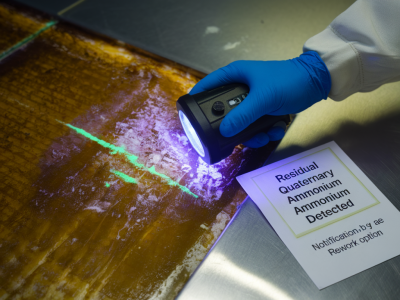
Visual and tactile inspection: note staining, pilling, fibre loss and tactile feel. Photograph samples to track deterioration.Absorbency test: a simple drip test—drop 10ml water on a fixed area and time absorption in seconds—or use a graduated beaker. Record averages from 5 replicates.Lint and residue: rub test against a dark surface; quantify by weight if practical (weigh cloth before and after controlled abrasion).ATP testing: use a handheld ATP luminometer (e.g., Hygiena SystemSURE). Take readings from cloth surfaces post‑laundry and after use. ATP gives a rapid proxy for organic contamination.Microbiology: when higher assurance is needed, send swabs to a lab for TVC, coliforms and specific pathogens. Sample a subset every 2–4 weeks.Mechanical integrity: measure tensile strength or simple tear test monthly. Some facilities use a basic tensiometer; otherwise track percentage of cloths reaching end‑of‑life due to damage.User feedback: collect shift‑level feedback from cleaning operatives on handling, drying time, smell, ease of wringing and perceived cleanliness.Phase 4 — Cost and lifespan analysis
Build a simple cost model covering capital, operational and indirect costs.
| Cost element | In‑house | Third‑party |
|---|
| Capital (washer, dryer, carts) | Depreciate over 5–10 years | N/A |
| Labour | Sort, load, operate, fold, store | Reduced on‑site labour, receiving & storage time |
| Utilities | Water, electricity, detergents | Included in service fee |
| Detergent & consumables | Direct purchase | Included |
| Transport | N/A | Collection/delivery costs |
| Replacement frequency | Measured in pilot (months per cloth) | Measured |
| Contamination risk cost | Estimate using ATP/micro data and potential incident costs | Estimate |
Key calculations I run:
Unit cost per use = (total cost over period) / (total number of uses during period).Break‑even horizon for capital purchase = capital cost / monthly savings vs third‑party fee.Sensitivity analysis for labour rates, detergent price changes and increased replacement rates.Assessing contamination risk
Contamination risk isn’t just a number—it’s process‑dependent. Even the best industrial laundry can fail if transport or storage reintroduces contamination. I evaluate risk across the whole chain:
Onsite handling: presorting contaminated cloths, use of designated carts, color coding and PPE for staff. Are soiled items bagged and separated?Laundry parameters: validated thermal disinfection (≥70°C for clinical loads), correct chemistry (alkaline detergents for greasy soils), and effective rinsing to prevent biocidal residues that compromise microfiber.Drying and storage: fully dry before folding; store in breathable, labelled bins away from traffic and contamination sources.Third‑party controls: look for documented chain of custody, vehicle hygiene, and secure delivery routines. Ask for ATP/TVC reports—reputable suppliers will share sample data.Pilot results interpretation
When I run this protocol, results usually fall into three practical categories:
In‑house cheaper and equal/less contamination risk — typical for large sites (>500 cloths) with predictable load patterns and capacity to invest in professional machines and trained staff.Third‑party cheaper and lower risk — often for smaller sites or businesses without space, staffing or capital for reliable in‑house laundering. Outsourcers provide validated processes and risk transfer.Hybrid model best — common outcome. Keep critical items (e.g., high‑risk healthcare cloths) on certified third‑party programs and launder low‑risk items in‑house to balance cost and control.Practical tips and real‑world lessons
Don’t cut corners on detergent and temperature: cheaper detergents or low‑temp cycles degrade fibers and increase long‑term cost.Track each batch: use QR tags or colour codes to monitor lifecycle and link performance back to washing parameters.Train staff: much of contamination risk comes from improper segregation and drying. A 30‑minute focused training and a laminated process checklist reduce risk more than expensive equipment.Negotiate SLAs with vendors: for third‑party providers insist on cleaning validation, rapid replacement response times and waste‑reduction commitments.If you’d like, I can share the spreadsheet template I use for the cost model and a printable sampling checklist for ATP and visual inspections—just tell me the size of your operation and whether you’re in healthcare, hospitality or corporate offices, and I’ll tailor those tools for you.