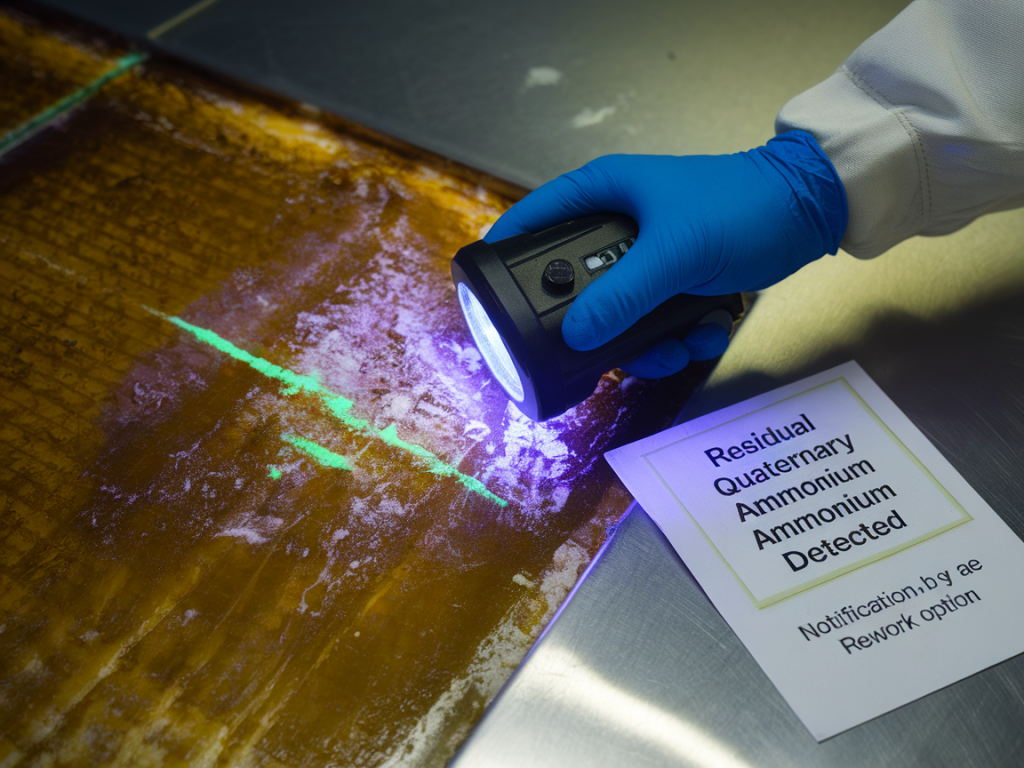
I often get asked on-site whether a surface still carries effective disinfectant residue after cleaning — especially when teams use quaternary ammonium compounds (quats). Knowing when to rework a touchpoint can save time, avoid unnecessary re-cleans, and ensure infection control measures are actually doing their job. Over the years I’ve developed a quick field test approach that’s practical, low-cost and gives reliable guidance for whether a rework is needed. Below I walk you through the how, why, what to buy, and how to interpret results in real-world settings.
Why test for residual quaternary ammonium?
Quats are widely used in commercial cleaning because they’re effective against many bacteria and enveloped viruses, and many ready-to-use products are convenient for touchpoints. But two common issues make testing useful:
Residues can build up on surfaces and sometimes interfere with future disinfection or leave sticky films that attract dirt.Incorrect dilution, short contact times, or wipedry surfaces can leave insufficient active disinfectant — or conversely leave too much residual product, which may indicate overdosing or poor rinsing.Testing helps you decide if a surface needs rework (a re-clean and/or rinse) or if it’s safe to leave as-is. It’s especially handy in healthcare, food service, and high-traffic offices where audit data is asked for.
What the field test detects
The field tests I use detect cationic surfactants — the chemical family quaternary ammonium compounds belong to. They don’t give an exact concentration like a lab assay, but they do provide a semi-quantitative result: negative (no detectable quat), low (trace), or high (residual present). That’s enough to inform the decision to rework.
What you need — quick shopping list
Over the years I’ve used several commercially available test strips and kits. For routine on-site testing I recommend:
Quaternary ammonium test strips or paper — e.g., QAC Test Strips for surface swabs (brands like Palintest or La Motte produce suitable products).Sterile swabs or cotton swabs (individually wrapped) for sampling touchpoints.Small sterile vials or tubes with 5–10 mL of neutralising buffer (some kits include neutraliser; if not use a buffer designed for quats — this prevents carryover reaction from inflating results).Disposable gloves, alcohol wipes and a log sheet (or your digital checklist) to record results and actions.Step-by-step field testing method I use
I keep this procedure simple so frontline teams can replicate it during audits or spot checks.
Wear gloves and identify the touchpoints you want to test (door handles, grab rails, lift buttons, desk edges).Label your tubes or vials with location and time.Moisten the swab in the neutralising buffer (if provided) and swab a defined surface area — typically 100 cm² is standard; for small items like handles, swab the whole surface.Place the swab into the tube, agitate for 10–15 seconds and remove the swab.Dip the QAC test strip into the tube for the time specified by the manufacturer (usually a few seconds), then lay it flat and wait for the colour development time (commonly 30–60 seconds).Compare the strip colour to the kit’s reference card and record the result: Negative / Low / High.Take a photo of the strip for audit records if required, and record any immediate action (e.g., rework scheduled, no action needed).Interpretation: when to rework
Here’s the decision logic I use in operations:
Negative — No detectable quat: rework is needed IF policy requires a residual disinfectant or if there’s visible contamination. Typically I schedule a re-clean using the correct product/dilution and ensure contact time is achieved.Low/Trace — Trace residues: this can mean insufficient application or partial breakdown. If the touchpoint was recently cleaned and the product claims residual activity, I’ll rework. If it was cleaned earlier and no ongoing disinfection is required, I may leave it but step up monitoring.High — Strong residual: indicates either proper application or overdosing/poor rinsing. I check the product label: if residue is acceptable (some quats are meant to leave residual), no rework is necessary. If film buildup or sticky feel is reported, I instruct a rinse with clean water and a damp microfiber cloth, then retest.Limits and caveats
Be upfront about what these kits can and can’t tell you:
They detect cationic surfactants but won’t identify the exact quat (e.g., benzalkonium chloride vs. others).Test strips give semi-quantitative results. They’re great for go/no-go decisions but not for regulatory compliance concentrations — for that you need lab analysis.Residues can be heterogeneous — one swab is representative of a small area only. For robust data, sample multiple points and track trends over time.Interference from other chemistries: some cleaning products and hand lotions can affect results. Using neutralising buffer and consistent sampling reduces false positives.Common scenarios and practical responses
From my experience across retail and healthcare sites, here are typical examples and how I handle them:
High-traffic reception desk shows negative on early-morning swabs — likely missed during night clean. Action: immediate re-clean and bring a quick refresher to the night team on contact time requirements.Staff pantry surfaces show high but sticky film reported — indicates overdosing. Action: rinse with warm water and microfiber, adjust dilution on dosing system, retrain staff.After using a new spray wipe product, benches show low — product may be incompatible with surface or applied too briefly. Action: review application method and consider switching product or increasing contact time.Recording and using the data
I advise building a simple log that records: date/time, location, result, product used, operator name, and action taken. A table like the one below fits neatly into a digital checklist or printer-friendly audit sheet.
| Location | Date/Time | Result | Product Used | Action | Operator |
| Reception desk | 2026-09-01 08:15 | Negative | Quat spray (1:500) | Re-clean, retrain night staff | J. Smith |
Safety and compliance
Always follow COSHH and product SDS guidance when handling quats and testing materials. Use gloves, avoid inhalation of concentrated solutions, and dispose of used strips and swabs in general waste unless contaminated with infectious matter (in which case follow clinical waste procedures).
Finally, I recommend integrating spot testing into your routine audits rather than treating it as a one-off novelty. Regular, documented checks not only improve frontline performance but provide evidence for clients and regulators that your cleaning programme is monitored and effective. If you’d like, I can share a printable audit template or a short staff briefing script used in our training sessions.