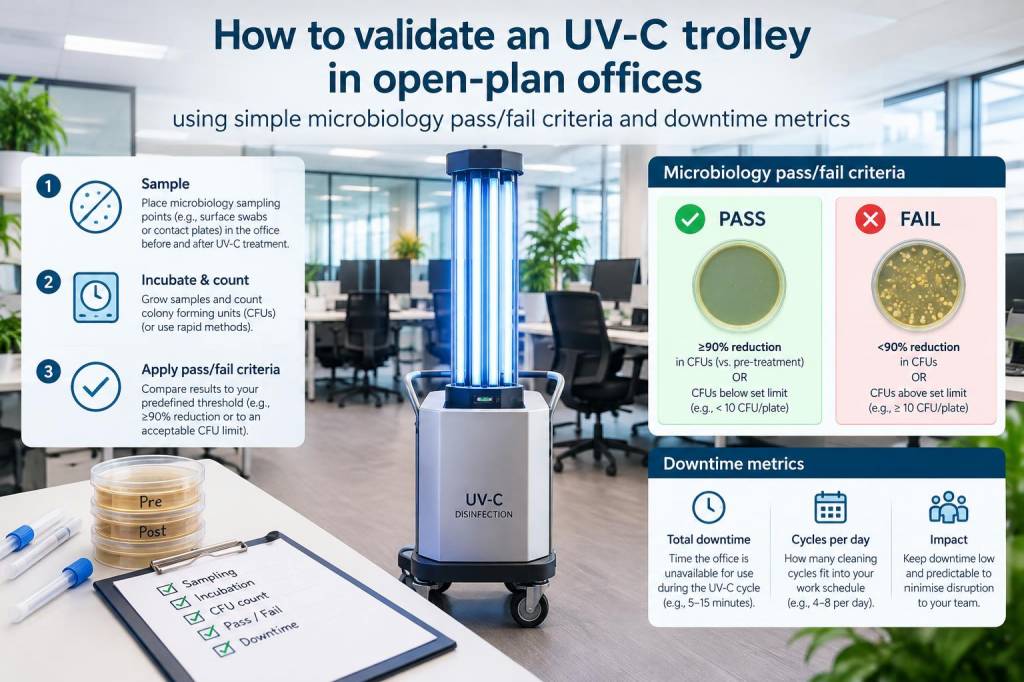
I recently completed a validation project for a UV‑C trolley in a large open‑plan office and I want to share the practical method I used, the microbiology pass/fail criteria I set, and the downtime metrics I measured. The aim was straightforward: demonstrate that the UV‑C trolley produced a reliable and repeatable reduction in environmental bioburden across representative workstations while keeping the time the workspace was out of use as low as possible.
Why validation matters in open‑plan offices
Open‑plan offices present unique challenges for UV‑C disinfection. There’s a lot of surface area, varied materials, obstructions like desks and screens, and people moving in and out. UV‑C is line‑of‑sight — shadows and surface orientation matter — so you can’t simply rely on vendor-specified run times. Validation removes guesswork: it tells you where the trolley performs well, where it doesn’t, and how long the room must remain vacant.
Overview of my validation approach
My process had three parallel strands: environmental microbiology sampling (before and after runs), UV‑C dose mapping with a radiometer, and operational timing (downtime metrics). I combine biological outcomes with physical dose data because a radiometer alone doesn’t prove microbial kill — it proves energy delivered. The microbiology proves the effect.
Sampling strategy: what I measured and why
I used a mix of contact plates (RODAC), swabs, and settle plates to capture realistic contamination in an office setting:
For a single open‑plan zone (~60 desks) I selected a stratified random sample of 20 surfaces: 10 high‑touch (desks, phones, armrests) and 10 low‑touch (undersides, monitor backs, shared printers). I also placed 4 settle plates across the zone at desk height to monitor airborne particulates.
Controls and repeatability
To be confident in results I used:
I repeated the cycle on three separate days to assess repeatability and to average out day‑to‑day variability.
Microbiology pass/fail criteria I used
There’s no single regulatory standard for CFU in offices, so I set pragmatic, measurable criteria based on best practices and infection control principles I use in commercial and healthcare-adjacent settings.
| Metric | Pass criterion | Notes |
| Surface log reduction | ≥2 log10 reduction (≥99%) compared with post‑manual cleaning baseline | Shows meaningful antimicrobial effect beyond manual cleaning |
| Absolute surface bioburden | <5 CFU/cm2 on contact plates or <10 CFU per 25 cm2 | A practical low‑risk target for office touchpoints |
| Settle plate counts | <25 CFU/plate after 1 hour | Monitors airborne fallout; used as secondary metric |
| Repeatability | Consistent results across 3 runs (SD <0.5 log for most sites) | Ensures reproducibility |
I treated the surface log reduction as the primary pass/fail. If most sample sites (≥80%) met ≥2 log reductions and ended below the absolute CFU threshold, I marked the run as a pass. If certain zones repeatedly failed, that triggered a targeted mitigation plan (shadowing, repositioning, longer dwell time).
Addressing shadowing and geometry
Open‑plan desks with monitors, dual screens, and personal items create many shaded areas. Practically, I found three interventions useful:
Using a radiometer and dose mapping
Alongside microbiology I measured irradiance with a UV‑C radiometer at representative heights and positions. This gave me a dose map and helped correlate biological kill with measured mJ/cm2 delivered. A useful rule of thumb I used: for common environmental bacteria, aim for ≥20 mJ/cm2 at the surface to reliably achieve ~2 log10 reduction, but material and surface soiling change that number.
Downtime metrics I captured
Operational viability matters for businesses. I measured total practical downtime as:
I tracked productivity impact: by staging runs during lunch breaks or staggered work-from-home windows we kept perceived disruption low. My recommendation is to plan UV‑C cycles so total zone downtime stays under an hour wherever possible; that makes it operationally acceptable for most offices.
Interpreting failures and corrective actions
Where the trolley didn’t meet the pass criteria I followed a structured approach:
Realistic expectations and final notes
UV‑C trolleys are a powerful tool in the toolbox, but they’re not a silver bullet. My validation showed clear, repeatable reductions on most touchpoints when combined with competent manual cleaning. The microbiology criteria I used are deliberately pragmatic — designed to show meaningful improvement while being achievable in a busy commercial environment. Combining biological sampling with dose mapping and practical downtime metrics gives you a defensible validation that you can present to facilities managers, health & safety, and leadership.