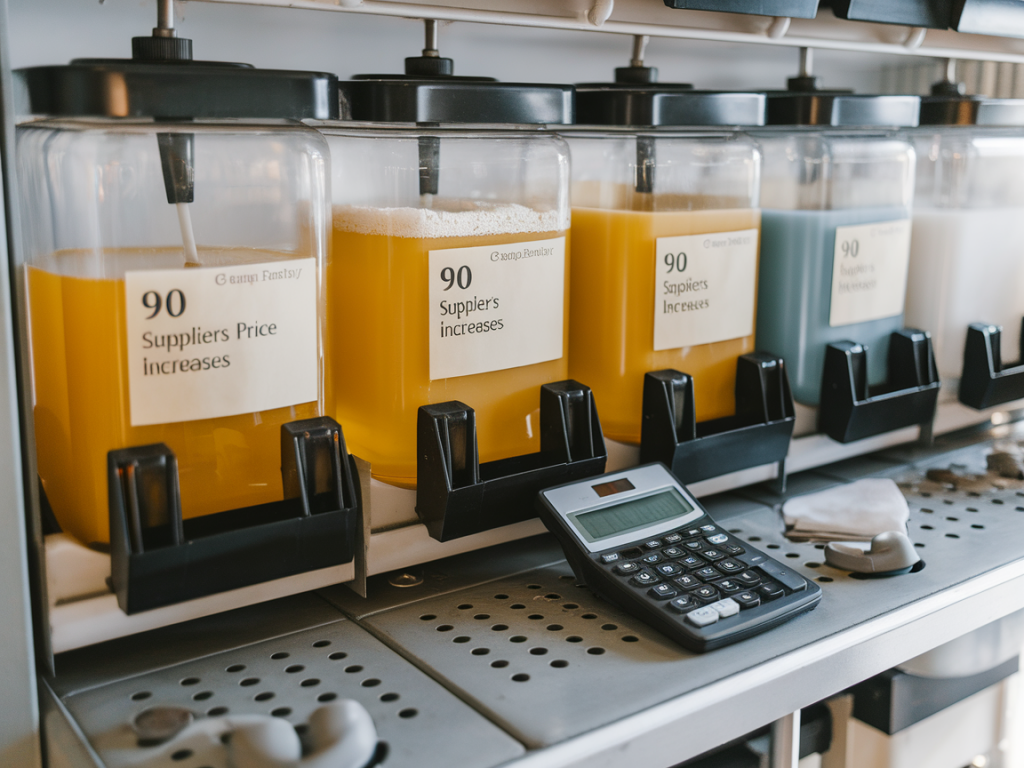
When a supplier raises prices, the instinctive reaction is to pass the increase up the chain or accept the hit to margins. I’ve found another path that often works faster and with better outcomes: switching to or expanding a refillable bulk dispenser system and proving its payback within 90 days. Below I walk through a practical, field-tested approach I’ve used with retail and corporate clients to quantify savings, build a compelling business case, and show real-world ROI that neutralises supplier price increases.
Why 90 days?
Ninety days is long enough to capture representative usage patterns, stock variability and staff behaviour changes, but short enough to influence quarterly budgets and supplier negotiations. It’s also a timeframe suppliers and finance teams respect—fast results create momentum.
What I measure first
Before any switch I collect baseline data. You need accurate, auditable numbers if you want to convince stakeholders.
Current monthly spend on single-use cartridges, sachets or pre-dosed items (broken down by product type: hand soap, sanitiser, laundry, surface cleaner).Delivery frequency and associated freight/handling costs.Pad waste and expiry/damage rates (how much product is wasted because bottles are damaged, cartridges expire, or staff over-dispense).Labour time for servicing and replenishing current systems (average minutes per site visit and visits per month).Incidents linked to product availability or dispenser failure (complaints, compliance issues).Collect these over one month and extrapolate to 90 days. I like to use conservative estimates—under-promise and over-deliver.
How refillable bulk systems save money
Bulk refillable dispensers reduce cost in several concrete ways:
Lower product unit cost: industrial bulk concentrates or bulk liquid are cheaper per litre than single-dose cartridges.Less packaging and freight: large, infrequent deliveries cut unit transport and packaging costs.Reduced waste handling and disposal costs.Fewer service visits: many bulk systems hold larger volumes so refill intervals increase.Less theft and stock pilferage: sealed bulk containers and site-controlled dispensing limit loss.Step-by-step method to prove payback in 90 days
These are the practical steps I follow on-site. You can replicate them in any business environment.
Identify a pilot group of sites or areas (3–6 locations representative of your estate).Install matched refillable dispensers for critical products (hand soap, sanitiser, surface cleaner).Start parallel tracking: keep detailed logs for both legacy and new systems—product used, refills, labour minutes, and incidents.Use a simple spreadsheet template (I provide one to clients) to capture daily/weekly consumption and costs.After 30, 60 and 90 days, run cumulative cost comparisons including direct product costs, labour, freight and waste disposal.Adjust for seasonality or unusual events then present the 90-day snapshot to finance and procurement.Sample 90-day ROI table
| Category | Legacy Cartridges (90 days) | Refillable Bulk (90 days) | Difference |
| Product cost (£) | £6,000 | £3,200 | £2,800 |
| Delivery & packaging (£) | £600 | £150 | £450 |
| Labour for refilling (hrs) | 18 hrs (valed at £15/hr = £270) | 8 hrs (valed at £15/hr = £120) | £150 |
| Waste disposal (£) | £120 | £40 | £80 |
| Total cost (90 days) | £6,990 | £3,510 | £3,480 |
In this example the refillable system pays back the incremental supplier price increase many times over in 90 days. Even if your starting numbers are less dramatic, replacing even one high-cost cartridge product usually shows quick wins.
Handling supplier objections
Suppliers will often raise concerns about hygiene, training, or compatibility with existing dispensers. Here’s how I respond:
Hygiene: use third-party certified concentrates and dispenser designs with anti-microbial coatings or sealed fill systems. Offer lab certificates and COSHH sheets.Training: provide a one-off 30–60 minute session for frontline staff and a short laminated refill procedure. I find staff confidence increases quickly and misuse rates fall.Compatibility: choose dispensers that are neutral or universal—brands like Tork, GOJO or Diversey have refillable options that work across many sites.Key metrics to present to finance/procurement
When I present results, I focus on metrics that procurement and finance care about:
Cost per usage event (e.g., cost per handwash or per surface clean).Reduction in delivery frequency and associated logistics cost.Labour hours saved (converted to £).Reduction in packaging/waste disposal costs.Payback period and internal rate of return (IRR) over 12 months based on 90-day run rate.Real-world example
I recently ran a 90-day pilot at a regional retail chain facing a 12% price increase from its soap and sanitiser supplier. We installed refillable dispensers across five stores and switched to a concentrated foam soap from a bulk supplier. Results:
Product spend dropped by 46% over 90 days.Delivery frequency moved from weekly to monthly—logistics costs fell by 60%.Labour for servicing reduced by 55% (store managers spent less time refilling small cartridges).The chain used the 90-day report to negotiate a value-added deal with the existing supplier—lower cartridge pricing plus reduced delivery costs for other non-replaceable items.Practical tips that save time
From experience these practical moves increase adoption and accuracy:
Label fills with date and operator initials to track accountability.Use calibrated dosing systems to avoid over-dispensing.Keep a small safety stock of original cartridges during transition to handle unexpected peaks.Document your assumptions and sensitivity points—finance will ask “what if usage increases 10%?”If you want, I can share a ready-to-use spreadsheet template and an audit checklist to run your own 90-day pilot. The trick is in collecting clean data and presenting it in procurement-friendly terms: cost per use, labour saved, and hard cash saved over the quarter. That’s usually enough to demonstrate that refillable bulk dispensers not only offset supplier price rises—they can turn a cost shock into an operational improvement opportunity.