When I first audited an office for waste management, the bins told a clear story: a third of what people threw away could easily be recycled, and a lot of the truly non-recyclable material was avoidable to begin with. Over the years running Bluebaycleaning Co, I’ve helped dozens of businesses redesign their waste streams so they send less to landfill and recover more recyclable material — reducing disposal costs and often creating small revenue streams from segregated recyclables. Below I share the practical, step-by-step guide I use with clients to cut landfill costs and improve recycling rates in offices.
Why waste segregation in offices matters
Waste segregation isn’t just a green tick-box. For offices it delivers three measurable benefits:
Lower landfill and disposal costs: Landfill and residual waste fees are typically higher than recycling collections. By diverting paper, cardboard, and some plastics into recycling streams you can reduce the weight and volume of expensive general waste collections.Improved recycling performance: Clean, correctly segregated streams have higher commodity value and are more likely to actually be recycled rather than incinerated or landfilled at downstream facilities.Health, compliance and reputation: Proper segregation reduces contamination (which can create COSHH risks for cleaners), helps meet sustainability targets, and demonstrates corporate responsibility to employees and clients.Understand the common office waste streams
Start by mapping what the office actually throws away. In my audits the typical streams are:
Paper and cardboard: Printed paper, envelopes, packaging, corrugated boxes.Plastics: Drink bottles, food trays, sandwich packaging, film and carrier bags.Glass: Bottles and jars from kitchens and meeting rooms.Food waste / organic: Leftovers, tea leaves, coffee grounds — depends whether the building operator accepts organics.General waste: Contaminated items, polystyrene, certain food-soiled products.Confidential waste: Shredding or secure disposal required for sensitive paper.WEEE and batteries: Small electricals, chargers, and single-use batteries should be collected separately for safe recycling.Practical bin setup that works
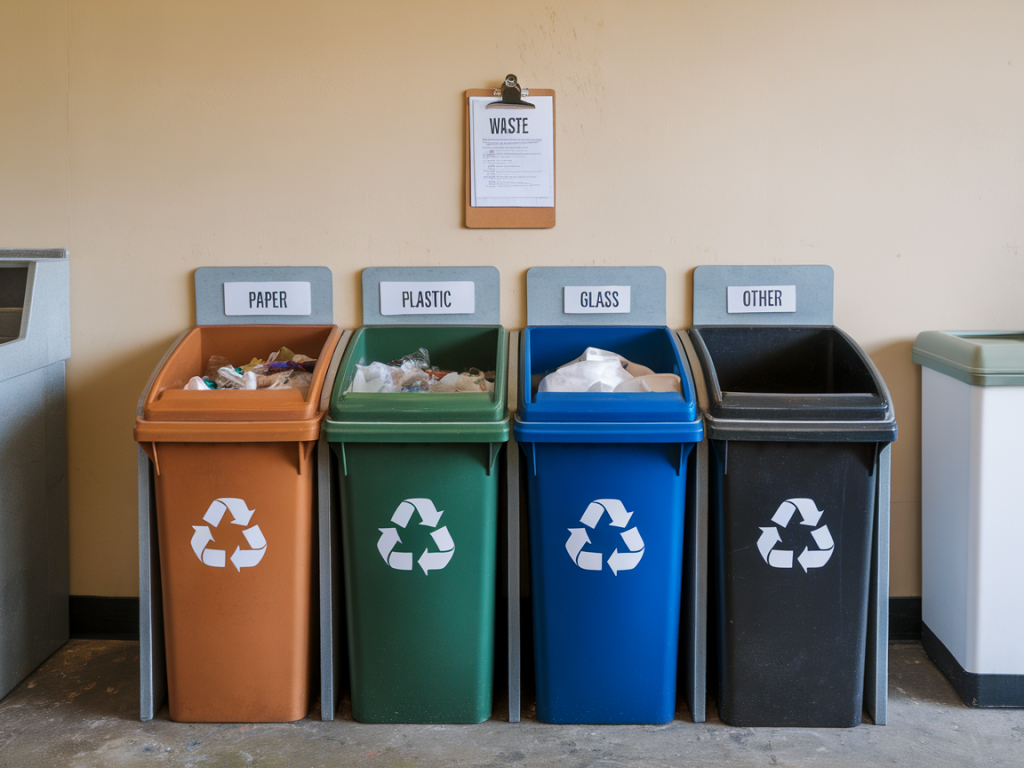
Most offices fail not because they don’t care, but because the bin setup is confusing or inconvenient. Here’s how I standardise a system that staff will actually use:
Use a simple, consistent colour code: Keep it uniform across floors and meeting rooms. For example: | Colour | Stream |
| Blue | Paper & Cardboard |
| Green | Glass & Plastic Bottles |
| Brown | Food / Organic (if available) |
| Black/Grey | General / Landfill |
| Red or Secure Bin | Confidential Waste |
Colour-coding combined with clear labelling reduces contamination. I recommend using robust, lockable bins for confidential waste and a small secure box at reception for batteries and small WEEE.
Signage and placement — make it obvious
Signage is where many schemes fail. I always design signs that show real examples of permitted and prohibited items — a picture of a sandwich wrapper next to a plastic bottle is clearer than text alone. Key placement tips:
Place dual or tri-stream stations in high-traffic areas (kitchenettes, printing hubs, meeting rooms).Keep a general waste bin next to recycling unless you want to force segregation — but ensure the recycling bin is equally accessible.At desks, provide small desktop caddies for paper and a single small general waste bin to encourage separation at source.Training and behaviour change
Bins and signs alone won’t shift behaviour. I run short, practical training sessions and provide desk drop leaflets that cover:
Why segregation matters (impact on costs, environment and compliance).What goes where — with photos of common items.How to flatten boxes and rinse basic food containers to avoid contamination.Introduce a feedback loop: monthly reports showing recycling rates and a quick note to staff celebrating improvements. Positive reinforcement works better than policing.
Managing tricky items and contamination
Contamination is the biggest enemy of recycling. Here’s how I handle common problem areas:
Food-soiled paper: Pizza boxes with grease cannot be recycled. Provide a separate food bin or instruct users to rip off clean cardboard panels and recycle only those.Plastic film and bags: Many municipal recycling services don’t accept soft plastics. Use a dedicated take-back box (supermarkets often accept plastic bags and film) or arrange a specialist collection.Coffee cups: Most disposable coffee cups have a plastic lining and are not widely recyclable. Encourage reusable cups and work with suppliers to install cup collection if available in your area.Confidential paper: Use a locked bin and schedule regular secure shredding — cheaper than overpaying for contaminated general waste.Measuring success and setting KPIs
To reduce landfill costs you must measure what you collect. I set these KPIs for clients:
Weight (kg) of general waste vs. recycling per month.Percentage of total waste diverted from landfill.Contamination rate (measured by random inspections).Cost per kg of waste collection (tracked monthly).Run baseline measurements for 4 weeks, implement segregation, then measure again at 3 and 6 months. Many clients see a 25–50% reduction in general waste weight and a corresponding drop in disposal costs within three months.
Case study: small corporate office
At a 120-person finance office I worked with, general waste made up 65% of collections but contained large amounts of cardboard and clean paper. Changes we implemented:
Introduced blue paper bins in every office and meeting room, and floor-level mixed recycling stations in kitchen areas.Installed a secure bin for confidential paper with weekly shredding.Ran a two-week awareness campaign with posters, emails, and two short training sessions.Worked with the waste contractor to add a separate cardboard compacting collection.Results: within 12 weeks the client reduced general waste tonnage by 42%, saved nearly 30% on their waste bills, and increased their recycling tonnage by 60% — a quick payback from improved segregation and reduced landfill levies.
Recommended products and partners
For hardware I often specify:
Simple pedal-operated bins from Brabantia or Rubbermaid for kitchens and meeting rooms (sturdy and easy to clean).Wall-mounted signage panels from local print suppliers or providers like Simply Signs to keep branding consistent.Secure shredding service from a local accredited supplier for confidential waste (price varies by frequency and volume).For waste collection, compare local authority vs. private contractors. Private companies sometimes provide better-separated collections and tailored reporting; however, councils can be more cost-effective for standard dry recyclables. I always recommend getting three quotes and checking reporting capability.
Quick practical tips you can implement today
Start a two-week “bin watch” — collect random samples from bins, note contamination and educate teams.Remove small general waste bins from desks and replace with desktop recycling caddies to encourage correct disposal at source.Introduce a simple monthly “recycling champion” role per floor to monitor bins and be a peer contact.Encourage suppliers to reduce packaging and use recyclable materials — sometimes swapping a product reduces waste at source much more than changing bins.Implementing effective waste segregation in offices is not a one-off project — it’s an operational shift that combines the right containers, clear signage, simple staff training, and measurement. When all those pieces are in place you’ll see lower landfill bills and a genuine uplift in recycling rates — and that’s a practical win for sustainability and the bottom line.