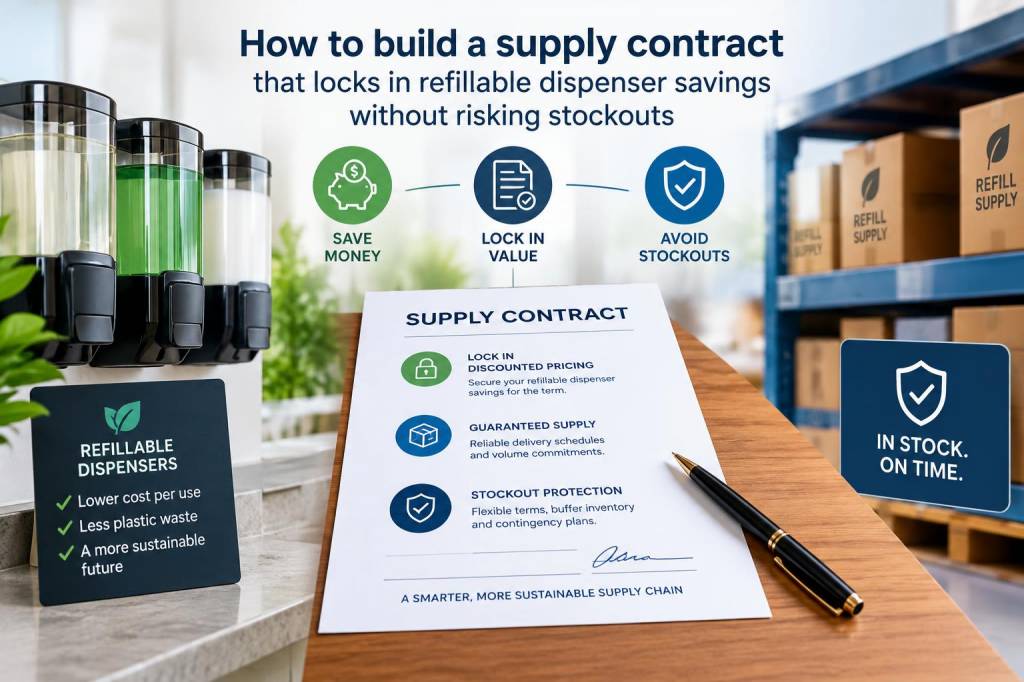
In my experience, the biggest mistake businesses make when switching to refillable dispensers is treating the supply contract as a simple price agreement. It is not. A strong contract should protect your budget, support steady service levels, and keep your sites from running short when demand rises unexpectedly. When I structure these agreements, I focus on one thing above all else: predictable savings without operational risk.
Refillable dispensers can cut packaging waste, reduce delivery frequency, and lower unit costs, but those gains only hold if supply is managed properly. I have seen sites save money in month one and then lose those gains because of missed deliveries, poor forecasting, or inflexible contract terms. A well-built contract is what turns a good eco decision into a reliable long-term operating model.
Start with real usage data, not assumptions
The first thing I do is look at actual consumption patterns. If you estimate usage from headcount alone, you will almost always get it wrong. Restrooms, kitchens, wash stations, shift patterns, visitor traffic, seasonal peaks, and cleaning frequency all affect refill demand. A warehouse with a steady night shift behaves very differently from a corporate office with fluctuating occupancy.
I prefer to base the contract on at least three months of usage data, and ideally six to twelve months if the site has seasonal swings. If the business is new or the refill system is being introduced for the first time, I use pilot figures plus a contingency buffer. That buffer is important. It protects against stockouts while the supplier learns the site’s actual rhythm.
When I review usage, I separate products into groups:
- High-turnover items such as hand soap, toilet tissue, and paper towels
- Moderate-use products such as surface cleaner refills and sanitiser
- Low-turnover or specialist items that need tighter control
This separation matters because not every product should carry the same reorder point or delivery frequency. A contract that treats every item identically is usually too blunt to work well.
Build flexibility into reorder rules
One of the best features of refillable dispensers is that they can reduce waste, but that benefit disappears if your supply chain is too rigid. I always push for reorder rules that allow adjustment without penalty. Demand changes, site access changes, and occupancy changes. A contract should expect that.
I like to define minimum and maximum stock thresholds for each product group. The supplier then commits to replenishment once stock hits the trigger point, rather than waiting for a manual order every time. This reduces the risk of a missed request and creates a more stable flow of supply.
I also recommend including a short review cycle. Monthly reviews work well in the early phase. Once usage stabilises, quarterly reviews are usually enough. During those reviews, I check:
- Whether stock levels matched actual demand
- Whether any dispenser locations used more product than expected
- Whether delivery timing caused any issues
- Whether refill volumes should be adjusted
This is where many contracts fail: they are signed and then left untouched. A refillable system works best when the contract allows practical refinement rather than locking everyone into a fixed pattern that may not fit real demand.
Protect savings with service level commitments
Lower packaging and lower unit costs are useful only if stock remains available. That is why I always include service level commitments in writing. These commitments should spell out delivery windows, emergency replenishment response times, and escalation steps if a delivery is missed.
For me, service levels are not a side note. They are a core part of the financial case. If a site runs out of hand soap or paper tissue, staff lose time, cleaning teams improvise, and the business may need a costly emergency purchase. Those hidden costs can wipe out the savings from refillable dispensers very quickly.
A practical contract should state:
- Standard delivery lead times
- Maximum acceptable stockout duration
- Emergency order process
- Named contact points for urgent issues
- Penalty or remedy terms for repeated failures
I also prefer suppliers who commit to visibility. If they can provide stock tracking or usage reporting, even better. That gives both sides a clearer view of what is happening before a problem becomes a shortage.
Use inventory buffers wisely
Some businesses try to eliminate every spare unit from storage in pursuit of efficiency. I do not recommend that. With refillable dispensers, a modest buffer is a form of insurance. It prevents disruption if there is a late delivery, a sudden increase in footfall, or an unexpected supply chain issue.
The right buffer depends on product criticality and site profile. For a busy public-facing site, I usually want enough stock to cover at least one full replenishment cycle plus a contingency margin. For lower-risk environments, a smaller buffer may be enough. The key is to make the buffer intentional, not accidental.
What I avoid is overstocking. Too much stock creates storage pressure, increases the chance of product aging, and can reduce the discipline of regular review. I want a contract that supports controlled resilience, not wasteful excess.
Match dispenser design to supply terms
Refillable dispenser savings are easier to protect when the dispenser format and the contract terms are aligned. If a dispenser uses large refills but the site only needs modest daily volume, you may be tying up space and capital unnecessarily. If a dispenser uses small cartridges in a high-traffic area, you may create too many changeovers and increase labour.
I look at the dispenser itself before I finalise the contract. The contract should reflect:
- Dispenser capacity
- Refill format
- Ease of changeover
- Compatibility with existing cleaning routines
- Storage footprint on site
That may sound obvious, but I have seen contracts written around product price alone, with no thought for dispenser design. Later, the team discovers that the agreed refill size does not match actual use patterns, and they either over-order or under-order. A better contract anticipates those practical realities from day one.
Negotiate pricing with volume bands and review triggers
Price stability matters, but so does fairness. I usually recommend tiered pricing based on realistic volume bands. That way, if usage grows, the business can benefit from better rates without needing to renegotiate every small increase. At the same time, if demand drops, the supplier is not forced into a model that no longer makes sense.
I also like to include review triggers for major shifts. For example, if a site expands, changes operating hours, or adds a new building zone, the contract should allow reforecasting without full renegotiation. That keeps the relationship practical and avoids disputes.
When I talk to procurement teams, I encourage them to ask for a clear answer to a simple question: What happens if our usage changes by 20 percent? If the contract cannot answer that cleanly, it probably needs more work.
Choose reporting that supports action, not just paperwork
Reporting should help you make decisions. If a supplier sends a spreadsheet full of numbers that nobody uses, that is not valuable. I want reports that show trends, exceptions, and recommended actions. That is what turns data into savings.
The most useful metrics are usually:
| Metric | Why it matters | What I look for |
|---|---|---|
| Consumption per site | Shows demand pattern | Stable trend or clear seasonal movement |
| Delivery punctuality | Protects stock availability | High on-time performance |
| Emergency orders | Signals weak forecasting | Low and declining frequency |
| Waste or overuse | Shows potential misuse | Investigation of outliers |
With this information, I can spot whether the contract is actually working. If emergency orders keep rising, the issue may be a bad reorder point, an under-sized buffer, or a dispenser that is not suited to the site. Reporting should help identify that quickly.
Make ownership clear across every team involved
A contract only works if everyone understands their role. Procurement may negotiate the commercial terms, but operations handles day-to-day use, cleaning teams manage refills, and site managers notice service gaps first. If ownership is unclear, small problems turn into supply failures.
I like to define responsibilities in plain language. For example, who checks stock, who approves changes, who contacts the supplier, and who signs off on monthly review notes. That clarity prevents duplication and avoids the common situation where everyone assumes someone else is watching the stock level.
Training also matters. Staff should know:
- How to identify low stock early
- How to report damaged dispensers
- How to record unusual usage
- How to follow the emergency reorder process
When people understand the system, refillable dispensers become easier to manage and far more reliable.
Write exit terms before you need them
I always pay attention to exit clauses. If the supplier underperforms, the business should be able to move on without excessive penalty. That does not mean the contract should be unstable. It means the agreement should be balanced.
Good exit terms cover notice periods, remaining stock handling, dispenser ownership, and data transfer. If the supplier holds useful usage records, you want a clean handover. If the business owns the dispensers, that should be explicit. If a transition is needed, the contract should explain how that happens without supply disruption.
This is one of those details that feels minor at signing but becomes vital later. A fair exit framework gives me confidence to commit to a longer contract because I know the business is not trapped if service quality slips.
When I put all these elements together, I am not just negotiating a supply deal. I am building a system that supports lower waste, steadier service, and better cost control over time. That is what makes refillable dispensers genuinely worthwhile: not simply the environmental benefit, but the ability to hold on to savings without creating stock risk.