Why enzymes are the go-to for coffee-shop upholstery stains
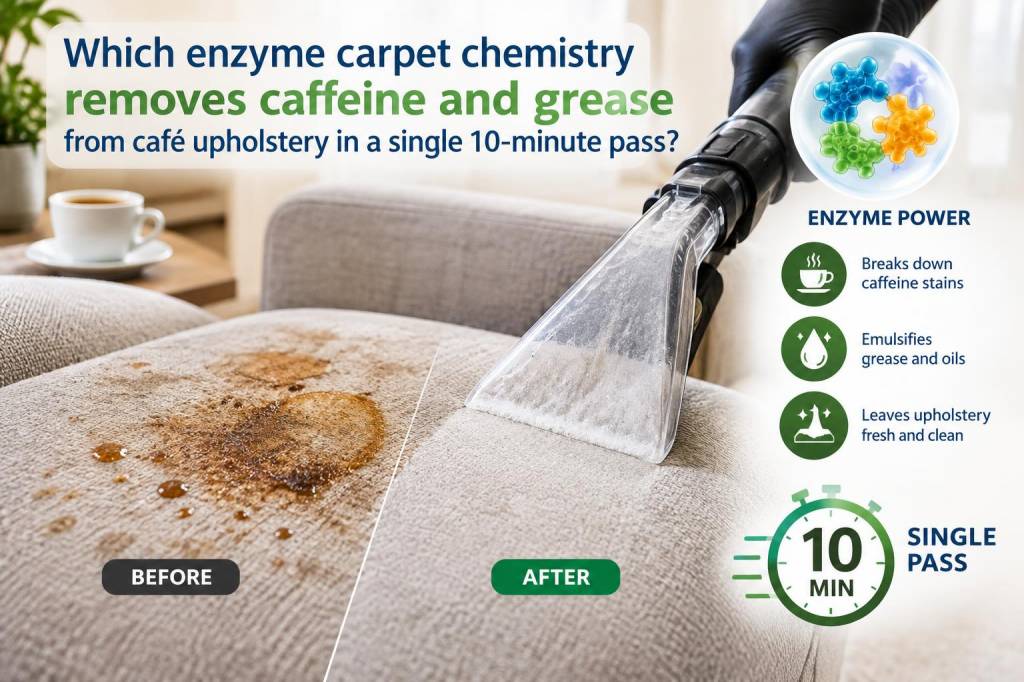
In cafés the two most common stubborn soils on upholstery are caffeine-based staining (espresso, filter coffee, tea) and grease (milk fats, pastry crumbs, oils). Traditional solvents or alkaline cleaners will shift surface soils, but they often struggle with the complex chemistry of coffee + grease: caffeine and tannins bind to fibres while fats form hydrophobic films that repel water-based detergents.
Enzyme-based chemistries give you an advantage because they attack the stain at a molecular level. Enzymes don’t simply solubilise; they catalyse the breakdown of specific molecules into smaller, water-soluble fragments you can remove in one pass. For café upholstery that typically means a combination of:
- Proteases — break down protein-based soils (milk proteins in lattes)
- Lipases — hydrolyse fats and oils into soluble glycerol and fatty acids
- Amylases — break down starches from pastries or thickened sauces
When blended with modern surfactants, wetting agents and mild chelants, these enzymes can lift caffeine/tannin complexes and disperse grease, allowing extraction equipment to remove them quickly. I’ve used blends that reliably remove coffee and greasy milk soils from café armchairs in a single 8–12 minute service window when applied correctly.
What “single 10‑minute pass” actually means in practice
People often assume “one pass” means spray and wipe. In professional upholstery cleaning it means a short, efficient sequence that includes:
- pre-spraying with the enzyme solution
- light agitation/dwell time (enough for enzymes to act)
- mechanical extraction or blotting to remove residues
For me, a dependable single-pass workflow looks like this on café upholstery:
- 0:00–0:90 — perform a quick assessment + patch test
- 1:30–2:30 — spray an enzyme blend evenly over the stained areas
- 2:30–6:30 — agitate lightly with a soft brush or low-speed orbital pad (this increases enzyme-substrate contact)
- 6:30–10:00 — extract with a portable hot-water extractor or heated upholstery tool (short rinse/suction)
That sequence gives about 3–4 minutes of active enzyme dwell and 3–4 minutes of mechanical removal — exactly why a good chemistry + method can make it in 10 minutes.
Key formulation elements to look for
Not all enzyme cleaners are equal. When selecting a product for caffeine + grease in cafés I check for:
- Multi-enzyme blends (protease + lipase ± amylase) — necessary to cover milk and pastry residues as well as coffee.
- Low-foaming surfactants — you want fast extraction without foam build-up in the recovery tank.
- Mild pH (neutral to slightly alkaline) — enzymes work best near their optimal pH; extreme alkalinity can denature them and damage sensitive upholstery fabrics.
- Added wetting agents and a small chelant — improves penetration into fibres and binds metal ions that can inhibit enzymes.
- Ready-to-dilute concentrates that state dwell times and dilution rates for upholstery.
Brands I’ve tested that hit these marks include Prochem’s enzyme upholstery formulations, Diversey Enzol (multi-enzyme), and some specialist products from Ecolab and Zep. There are also independent enzyme blends like EnzClean that work well at the right dilution — always check the manufacturer’s technical data sheet for fabric compatibility.
Practical single-pass recipe and settings (what I use)
These are field-tested parameters I use when I need a reliable 10-minute single-pass result on synthetic or blended upholstery fabrics found in cafés. Always patch test first.
| Step | Detail |
|---|---|
| Product | Multi-enzyme upholstery cleaner (protease + lipase + amylase), low-foam |
| Dilution | 1:40 to 1:80 depending on soil load (stronger for heavy grease) |
| Application | Spray evenly from 20–30 cm using a pump sprayer or atomiser |
| Dwell | 3–5 minutes (keep surface moist) |
| Agitation | Soft nylon brush or low-speed orbital pad for 1–2 minutes |
| Extraction | Portable extractor with heated rinse (40–50°C), low-foam setting, moderate suction |
| Drying | Air movers if needed; fabrics should be slightly damp after extraction |
Compatibility and safety notes
I always take these precautions:
- Do a hidden patch test for colourfastness and fibre reaction — enzymes can brighten or slightly change tone on some dyes.
- Avoid high-alkaline boosters before or after enzyme use — they can denature the enzymes or leave residues.
- Follow COSHH guidance: some enzyme powders/aerosols are sensitising; use gloves and ensure ventilation.
- Rinse adequately — enzymes left on a surface can continue acting (not usually desired), and residue attracts soils.
Troubleshooting tips
If a single pass isn’t fully removing the stain, I check these points:
- Was the dilution too weak? Increase concentration slightly within manufacturer limits.
- Was there enough agitation? Enzymes need contact; a light mechanical action helps.
- Was the extraction effective? Low suction or too much foam will leave residues—adjust machine settings or pre-rinse.
- Is the fabric heavily soiled or oil-impregnated? Some extreme cases need a two-step: a degreasing pre-spray followed by enzyme treatment.
Type of equipment that maximises success
For a true 10-minute single-pass result I use:
- A quality pump sprayer or atomiser for even pre-spray.
- A low-speed orbital machine with a soft pad for agitation (gentle on upholstery).
- A portable heated extractor with adjustable water flow and strong vacuum (heated rinse shortens dwell-to-extract time).
Combining the right chemistry, a brief but intentional dwell, light mechanical action and an effective extraction will typically get caffeine and grease out of café upholstery in one 10-minute pass. When I preach efficiency to clients, this sequence — not a miracle product — is the reason it works reliably in real-world operations.