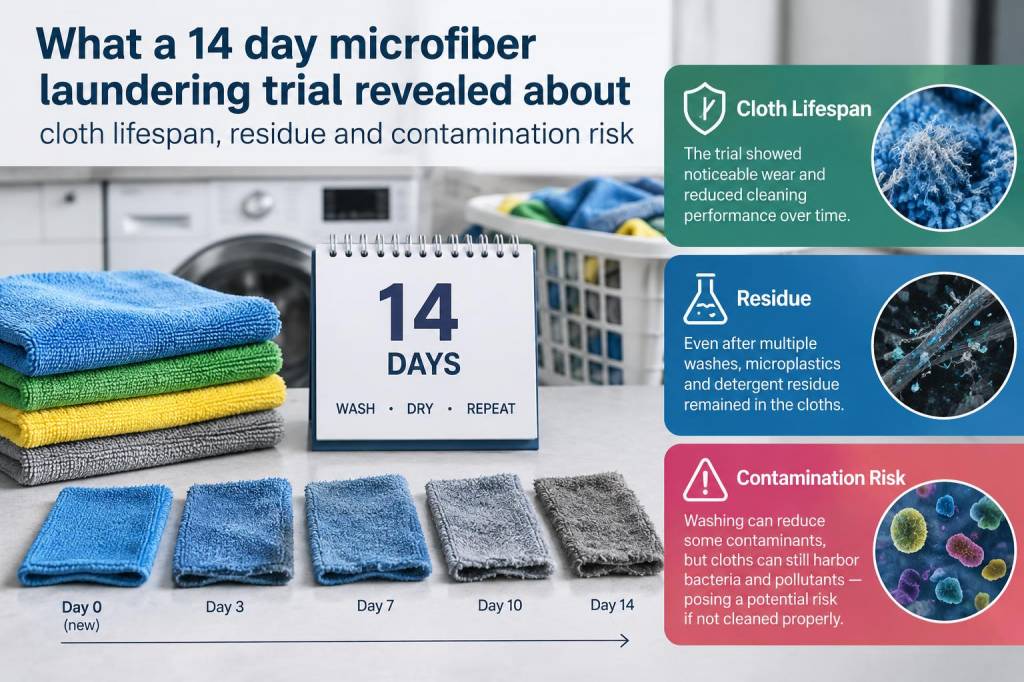
I ran a 14-day laundering trial because I wanted a clear answer to a question I hear often from facilities teams: what actually happens to microfiber cloths after repeated washing? Many people assume a cloth is either “clean” or “worn out,” but in practice the story is more complicated. Fibre loss, visible residue, absorbency changes, and contamination transfer all move at different speeds. That matters because cloths sit at the centre of daily cleaning performance, especially in offices, healthcare settings, hospitality venues, and busy commercial buildings where one weak point can affect an entire cleaning routine.
For this trial, I tracked a batch of standard commercial microfiber cloths through 14 consecutive days of use and laundering. I wanted evidence I could use in real operations, not theory. I focused on three things: lifespan, residue retention, and contamination risk. I also looked at what the washing method itself did to the cloths, because a cloth can fail long before it looks visually ruined. In my experience, that hidden failure is often what causes inconsistent results on site.
What I set out to measure
I chose a mixed-use cleaning programme that reflected ordinary commercial conditions. Cloths were used for desks, touchpoints, glass, washroom surfaces, and general wipe-down tasks. I separated cloths by colour and task to reduce cross-use, then logged every wash cycle, drying method, and inspection result. I did not want a laboratory-only outcome. I wanted to see what happens under real pressure, with real handling, real time limits, and real laundry habits.
The three main measures were simple:
- Lifespan: whether the cloth still held structure, edge stability, and cleaning performance
- Residue: whether detergent, soil, grease, or fibre fluff remained after washing
- Contamination risk: whether the cloth could still be used safely without spreading soil or microbes from one task to another
I also kept an eye on softness, absorbency, and drying time. These are small details, but they often predict failure before a visible tear appears.
What I noticed after the first few wash cycles
The first few days were reassuring. The cloths came out looking bright, and most kept their original shape. That said, I noticed an early pattern: not all dirt was leaving equally. Cloths used on greasy touchpoints and kitchen-adjacent areas held onto a thin film after washing, even when they looked clean at a glance. Under stronger light, that film appeared as dull patches and slight stiffness in some zones, especially near the cloth centre where grime was most concentrated.
At this stage, the cloths had not failed structurally, but the performance shift was already visible in use. A cloth with lingering residue does not glide as easily, and it does not pick up fine dust as well. Users often mistake that for “just a bad wash,” when it is actually an early warning sign that detergent dose, water temperature, or rinse quality needs attention.
I also saw a difference between cloths dried quickly and cloths left damp for longer periods. Faster drying reduced odour and made the cloths feel fresher, while slower drying created a slight musty smell in a few samples. That may sound minor, but odour is often the first clue that microbial load is increasing.
Midpoint findings: residue was the real problem
By the middle of the trial, the biggest issue was not obvious wear. It was residue accumulation. Some cloths were still intact, but they were becoming less effective because residues were embedding into the fibre matrix. This was especially clear in cloths used on mixed soil loads. When a cloth handles dust one moment and oily fingerprints the next, the washing process has to work much harder to restore it fully.
I found that residue affected four practical outcomes:
- Water spread became less even during wiping
- Fine dust pickup declined
- Streaking increased on glass and polished surfaces
- Cloths felt heavier and less responsive after drying
That last point matters more than people expect. A cloth that feels heavy after drying is often carrying hidden residue or incomplete rinse-out. In a busy workplace, staff may keep using it because it still “looks okay,” but the cleaning outcome becomes less reliable. I have seen this repeatedly in audits: equipment failure is not always dramatic. Sometimes it is a slow slide in performance that no one notices until standards begin to drift.
What contamination risk looked like in practice
The contamination issue was more about handling than appearance. A cloth can look spotless and still pose a risk if it has been washed, dried, folded, and stored in a way that allows recontamination. I paid particular attention to how cloths were sorted after washing. Mixed loads, poor segregation, and storage in open areas all increased concern.
Three risk points stood out most clearly:
- Shared wash loads increased the chance of cross-soiling between cloth types
- Inadequate rinse performance left behind residues that could support microbial growth
- Slow or humid drying conditions increased the chance of odour and contamination persistence
I was especially interested in cloths used for washroom tasks. Even when they were washed thoroughly, they needed stricter handling than general-purpose cloths. I would not recommend using a single laundry system without clear separation rules if a site handles sanitary areas, food-adjacent spaces, and general office cleaning. The trial reinforced something I already believed: laundering alone does not guarantee hygiene. Process control matters just as much.
Where cloths started to fail structurally
True physical wear appeared later than I expected. The cloths did not collapse quickly, which is good news for cost control. However, after repeated wash cycles, I began to see fraying at the edges, slight distortion in shape, and reduced fibre lift in a few samples. This did not make them unusable straight away, but it did shorten their useful life.
The cloths that failed earliest tended to share three traits: they had been overloaded in the wash, dried at high heat, or used on heavier soils without a dedicated pre-rinse step. That combination seems to punish the fibre structure. The cloths that lasted longer had steadier performance because they were handled consistently and washed in smaller, better controlled batches.
One useful lesson from the trial was that lifespan is not only about fabric quality. It is also about process discipline. A good microfiber cloth can still fail early if the laundry routine is careless. A mid-range cloth can last much longer if the washing system is managed properly.
What I would change in a real cleaning operation
After this trial, I would make several practical changes in any site using microfiber at scale. None of them are expensive, but all of them improve results. I would separate cloths by task, use consistent colour coding, and avoid mixing wash categories. I would also push for a clearer drying standard, because incomplete drying creates avoidable risk. If a site relies on cloths for rapid turnaround, drying control becomes as important as washing itself.
I would also tighten detergent control. Too much detergent can leave residue behind; too little can leave soil in the fibres. Finding the right balance matters more than people think. In my view, many laundry problems blamed on “cheap cloths” are really process problems. Once that changes, performance improves quickly.
Here is the practical checklist I would apply after this trial:
- Separate cloths by task and contamination level
- Use controlled wash loads rather than full-capacity overloads
- Check rinse quality, not only visual cleanliness
- Dry fully before folding or storage
- Inspect edges, texture, and absorbency on a fixed schedule
- Remove cloths from service before visible wear becomes severe
Trial results in plain view
| Area observed | Early stage | Midpoint | End of trial |
|---|---|---|---|
| Lifespan | Strong structure, minimal change | Slight edge wear, still usable | Noticeable wear in a few samples |
| Residue | Low at first, except greasy cloths | Clear build-up in mixed-soil cloths | Residue affected texture and wipe quality |
| Contamination risk | Manageable with good handling | Higher in poorly segregated loads | Controlled only where drying and storage were strict |
| Cleaning performance | Consistently strong | Variable in residue-heavy cloths | Decline in cloths with poor wash history |
The strongest overall finding was simple: microfiber lifespan is closely tied to laundry quality, not only fabric grade. Residue build-up appeared before serious physical damage. Contamination risk grew when drying and storage were weak. And cloths that looked acceptable at a glance were not always delivering reliable cleaning performance.
If I were advising a business manager or site supervisor, I would say this: treat microfiber laundering as part of your cleaning control system, not as an afterthought. Once that mindset shifts, cloth replacement becomes more predictable, waste drops, and surface cleaning becomes more consistent across the whole site.