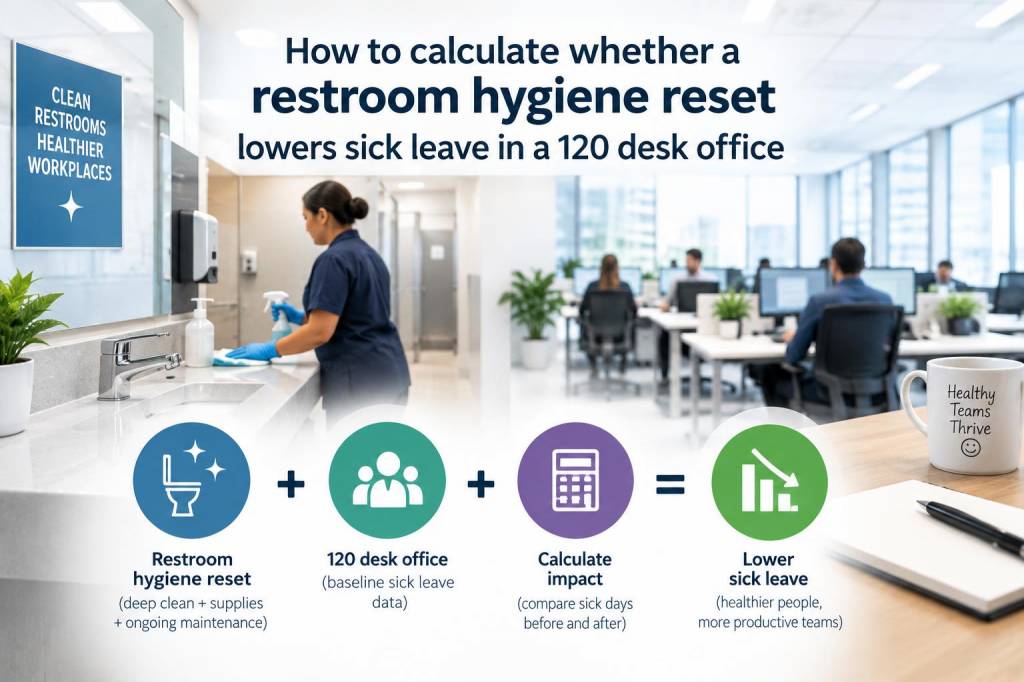
When I assess whether a restroom hygiene reset can reduce sick leave in a 120-desk office, I start with a simple idea: if hygiene improves, exposure risk should fall, but I need evidence, not assumptions. In my work, I have seen too many teams spend money on visible changes and then rely on instinct to judge results. I prefer a clearer approach. I measure before, measure after, and compare what changed in a way that accounts for seasonality, occupancy, and normal variation in staff absence.
A restroom hygiene reset is not only about appearance. It usually means a more disciplined cleaning schedule, better consumable stock control, improved touchpoint disinfection, faster response to spills, handwashing support, and clearer standards for auditing. In a 120-desk office, those changes can influence how germs move through a workplace, especially where shared facilities are used all day by a rotating population of staff, visitors, and contractors.
Start With A Baseline You Can Trust
I never begin with sick leave figures alone. If I only look at absence days, I may miss what actually caused the change. I first build a baseline for at least three months, and I prefer six months if data is available. That baseline should include:
- Average monthly sick leave days
- Number of absence incidents
- Average desk occupancy
- Restroom cleaning frequency
- Audit scores for hygiene condition
- Reported supply shortages, such as soap or paper towels
- Complaints about odour, cleanliness, or blocked bins
I also separate absence volume from absence pattern. A small number of long absences may not be related to hygiene at all, while many short absences can sometimes suggest a broader workplace issue, especially during winter months or periods of high footfall.
For a 120-desk office, I usually calculate absence per 100 employees so I can compare results with other sites or time periods. If the office has 120 desks but only 95 average daily users, I still treat it as a 120-desk environment because shared facility pressure is shaped by capacity, not only headcount.
Define What A Hygiene Reset Actually Changes
To calculate impact properly, I need to know exactly what changed. “Better cleaning” is too vague. I make the intervention specific. For example, a restroom hygiene reset might include:
- Cleaning and disinfection three times daily instead of once
- Extra attention to flush handles, taps, locks, and door hardware
- Stock checks at fixed times
- More frequent waste removal
- Air freshening only after proper cleaning, not as a substitute
- New audit sheets and supervisor sign-off
- Staff signage that encourages handwashing and reporting of issues
I find it useful to record the date each change begins. If several changes happen at once, I note them separately. That way, when I review the results, I can see whether the strongest improvement came from frequency, quality, compliance, or a combination of all three.
Use A Simple Before-And-After Formula
The most practical calculation is a before-and-after comparison. I usually use this formula:
Change in sick leave percentage = ((After period sick leave rate - Before period sick leave rate) ÷ Before period sick leave rate) × 100
For example, if the office had 42 sick leave days across 120 desks in the three months before the reset, and 30 sick leave days in the three months after, I first convert both periods into a rate. If each period covers roughly the same number of working days, a simple comparison may be enough for an early view. If one period includes more holidays or a flu wave, I adjust the analysis.
I also look at days lost per desk and incidents per employee. A sample view might look like this:
| Measure | Before Reset | After Reset | Change |
|---|---|---|---|
| Sick leave days | 42 | 30 | -28.6% |
| Absence incidents | 18 | 12 | -33.3% |
| Restroom audit score | 68% | 91% | +23 points |
| Soap shortages | 9 | 1 | -88.9% |
This does not prove causation on its own, but it creates a strong signal. If hygiene conditions improved sharply and absence dropped soon after, I have a credible case to explore further.
Adjust For Occupancy, Season, And Noise
This is where many people make mistakes. A restroom reset may look effective simply because illness rates fall naturally after a winter peak. That is why I adjust for context. I ask myself:
- Was the comparison made in the same season?
- Did occupancy change because people worked from home more often?
- Were there wider illness outbreaks in the area?
- Did another workplace change happen at the same time?
- Were managers more strict about reporting absence after the reset?
If possible, I compare the office with another similar site that did not receive the hygiene reset. That gives me a rough control group. If both sites see the same decline in sick leave, I am less likely to credit the restroom work alone. If only the reset site improves, the case becomes stronger.
I also track whether the office had any operational disruptions. A temporary rise in meetings, visitors, or catering events can increase restroom use and affect both hygiene standards and illness spread. In a 120-desk office, even small behaviour changes can matter because shared facilities are under constant pressure.
Connect Hygiene Changes To Business Value
From a business and marketing angle, I care about more than cleanliness. I want to know whether the reset produces a return. Reduced sick leave can mean fewer lost hours, better service delivery, less pressure on managers, and stronger team morale. If an office loses fewer working days, it may also avoid overtime costs and project delays.
I estimate value using this approach:
Estimated savings = avoided sick days × average daily labour cost
If five sick days were avoided and the average cost of one lost day is £180, the immediate direct saving is £900. That is only part of the story. I also consider indirect gains such as fewer handover problems, better attendance stability, and improved confidence in workplace standards.
When I present this to clients, I do not oversell it. I say that a restroom hygiene reset can be a sensible health measure and a practical operational investment, but it should be measured like any other business change. That makes the case stronger and more credible.
Look At Leading Indicators, Not Only Sick Leave
Sick leave is important, but it is a lagging indicator. By the time absence rises, the problem has already affected the office. I prefer to monitor leading indicators as well:
- Restroom audit compliance
- Time taken to restock consumables
- Number of hygiene complaints
- Frequency of touchpoint cleaning
- Condition of handwashing stations
- Staff confidence in facility cleanliness
I often ask a short anonymous question set before and after the reset. For example: Do staff trust the restroom standards? Do they notice soap, paper, and cleanliness consistently? Do they avoid the facilities because of odour or poor condition? These answers help me understand whether behaviour is likely to change in a way that affects infection risk.
What I Look For In A Real Result
When I review a project like this, I want three things to line up. First, hygiene scores must improve. Second, supply failures and complaints must fall. Third, sick leave should drop in a way that is more than normal random variation. If all three happen together, I treat the reset as a meaningful contributor.
I also pay attention to timing. If the biggest improvement happens in the first four to eight weeks, that may indicate a strong behavioural and environmental effect. If the change is delayed, I ask whether staff habits or cleaning compliance took time to settle. Sometimes the office needs education as much as cleaning.
In practice, I find the strongest results when the restroom hygiene reset is paired with clear responsibility, visible standards, and regular review. A cleaner restroom alone helps, but a managed system helps more. That is especially true in a 120-desk office where shared facilities act like a daily contact point for nearly every employee.
When I calculate the outcome, I keep my reporting honest, specific, and evidence-led. I look beyond surface shine and ask whether the reset changed behaviour, reduced contamination opportunities, and supported healthier attendance patterns. That is the kind of analysis that turns a cleaning improvement into a credible business case.