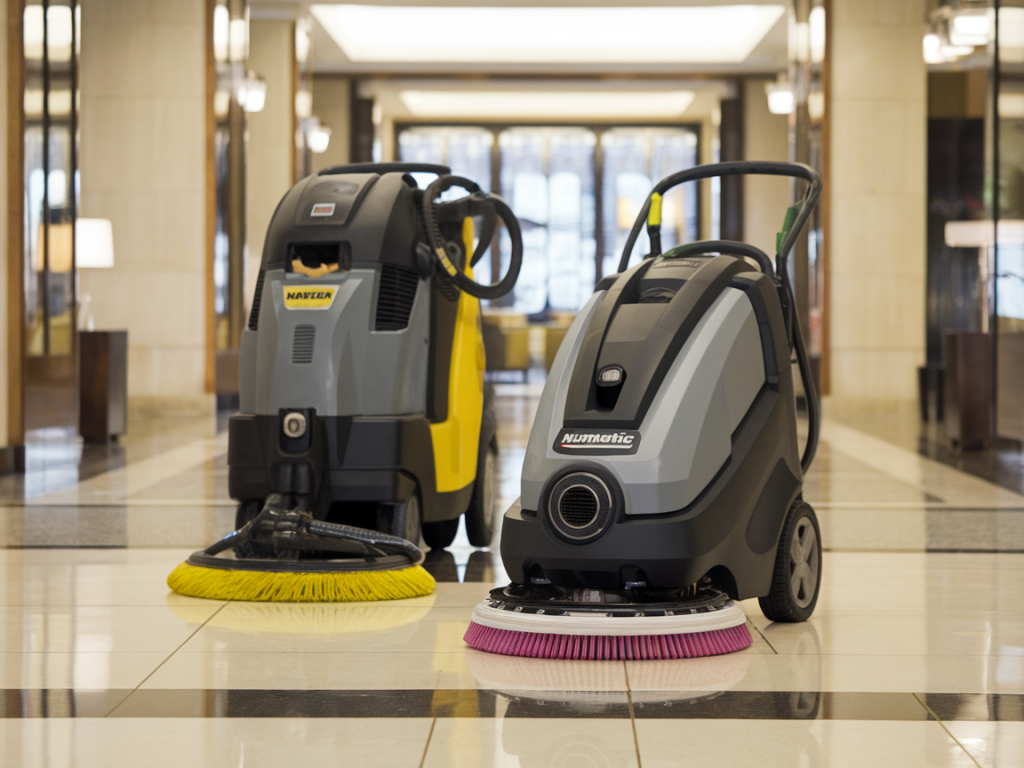
When I’m advising hospitality clients on floor care, the conversation inevitably turns to two big names: Kärcher and Numatic. Both brands have loyal followings, proven track records, and machines that handle heavy use — but they’re designed with different priorities in mind. Over the last decade I’ve run both on sites that see constant footfall: hotel lobbies, conference centres, and busy restaurant kitchens. In this article I’ll walk you through the practical considerations that should guide your choice for high‑traffic hospitality environments.
Start with the site realities
Before you compare models, take a clear-eyed inventory of the environment. I always ask a few core questions:
- What is the surface mix (hard floor, vinyl, tiled, carpeted rugs)?
- How many square metres need cleaning per shift and how often do you need to clean?
- Is noise a concern (late‑night corridors, function rooms, early mornings)?
- Do you need rapid drying times to keep guest areas accessible?
- What skill level do your operatives have — and how much training time can you afford?
These practical points will often determine whether you prioritise productivity, simplicity, or specialist features.
Performance and productivity
In high‑traffic hospitality sites the two metrics that hit budgets fastest are machine coverage per hour and downtime. Kärcher’s ride‑on and walk‑behind scrubbers tend to excel on productivity: larger solution and recovery tanks, wider brush decks, and advanced battery options make them ideal where you need to cover big areas quickly. I’ve recorded coverage rates of 2,000–3,000 m²/hour on certain Kärcher models when used on open lobby areas.
Numatic, by contrast, focuses on robustness and ease of use. Their machines — especially the single‑disc and scrubber dryer ranges — are often slightly narrower in path width but extremely durable and forgiving in tricky spaces. They’re a great choice if you have tighter corridors, frequent obstacles, or a small team where reliability and low maintenance are crucial.
Ergonomics and ease of training
Staff turnover in hospitality can be high. Machines that are simple to use reduce mistakes and downtime. Numatic has built a reputation for intuitive controls and plug‑and‑play simplicity: start/stop is obvious, brush changes are easy, and routine maintenance is straightforward. For teams that need minimal training, Numatic is a strong contender.
Kärcher machines offer more features — eco modes, water recovery options, automatic chemical dosing — which can improve efficiency and reduce costs once operators are trained. But those features add complexity. If you have a skilled facilities team or can invest in training, Kärcher’s ergonomic design and adjustable settings can deliver superior results over time.
Noise and guest experience
Noise matters in hotels. Late‑night cleaning or early morning turnover requires machines that are quiet. Numatic machines are generally quieter at work, especially their brush and pad systems on smaller models. Kärcher’s high‑performance scrubbers and sweepers can be louder but their ride‑on variants often allow cleaning with less presence in guest spaces because they cover areas far more quickly.
Drying time and slip risk
Fast drying is non‑negotiable in hospitality — wet floors lead to guest complaints and slip incidents. Kärcher scrubber dryers typically have powerful vacuum systems which leave floors drier, quicker. If you need minimal downtime for public areas after cleaning (entrances, dining halls), Kärcher has an edge.
Numatic machines can achieve good results with the right pads and workflows, but you may need to adjust settings or accept slightly longer drying times in certain conditions.
Durability, warranties and service
I’ve found both brands to be robust if maintained properly. Numatic’s simple engineering means fewer things to go wrong — a big advantage on sites where a rapid service response isn’t guaranteed. Kärcher offers extensive dealer networks and spare parts availability; when uptime is vital and you can access manufacturer support quickly, Kärcher’s service ecosystem is very attractive.
Cost of ownership
Purchase price is only part of the story. Consider:
- Energy consumption and battery lifespan
- Consumables: pads, brushes and squeegees
- Chemical dosing efficiency and usage
- Planned maintenance intervals and spare part costs
In my projects, Numatic often comes out cheaper on day‑to‑day running costs because their machines are easier to maintain in‑house and use fewer complex parts. Kärcher can be more cost‑effective when higher productivity reduces operator hours and when reduced chemical/water use is factored in through intelligent dosing systems.
Specialty needs: carpets, stone, and outdoor areas
Think about the surface types you maintain. For large carpeted reception areas with deep embedment cleaning needs, Kärcher’s extractor and carpet cleaning range provide strong performance. Numatic’s carpet cleaners are excellent for frequent light cleaning and quick spot treatment.
For stone and sealed surfaces, look for adjustable brush pressure and pad speed. Kärcher’s variable settings give more flexibility; Numatic wins for ease of use when you need consistent results without constant adjustment.
Practical comparison table (typical characteristics)
| Characteristic | Kärcher | Numatic |
|---|---|---|
| Productivity (m²/hr) | Higher (wide decks, large tanks) | Moderate (narrower paths) |
| Ease of training | Requires training for advanced features | Very easy, intuitive controls |
| Drying time | Faster (strong vacuums) | Good with correct setup |
| Noise | Varies; some models louder | Quieter on many models |
| Service network | Large dealer network, good parts availability | Simple repairs; robust components |
| Cost of ownership | Potentially lower with high utilisation | Often lower for small teams |
My decision framework — how I choose for a site
When I evaluate machines for a specific hospitality client I use a simple scoring approach:
- Operational fit (40%): Does the machine match daily workflows and peak traffic patterns?
- Guest impact (20%): Noise, drying time, and footprint in public areas.
- Total cost (20%): Purchase plus predictable running costs over 5 years.
- Maintenance & support (20%): Local service availability and spare parts lead times.
For large conference centres and airport hotels where coverage and speed matter most, Kärcher usually wins my recommendation. For boutique hotels, bed & breakfasts, and sites with constrained back‑of‑house storage or limited maintenance resource, Numatic tends to be the safer, more economical choice.
If you want, tell me about your site (floor types, size, cleaning frequency), and I’ll suggest a shortlist of models from both brands that match your needs — including expected coverage rates, likely running costs, and what training to plan for.