Health & Safety

How to validate a fragrance-free disinfectant across five touchpoint types with clear pass/fail microbiology criteria

How to validate a fragrance-free disinfectant across five touchpoint types with clear pass/fail microbiology criteria

I’m often asked how to prove — in a clear, repeatable way — that a fragrance-free disinfectant actually works where it matters: the high-touch surfaces people use every day. Over the years I’ve validated products in retail, office and healthcare settings, and I’ve learned that a robust validation has three parts: standardised lab testing, realistic carrier tests, and a simple field sampling protocol with objective pass/fail microbiology criteria. Below I share a practical workflow you can implement at your site and a set of microbiology thresholds I use for five common touchpoint types.

Why fragrance-free matters — and why validation must be evidence-based

Clients request fragrance-free products for staff sensitivities, patient comfort and for compliance in scent-free zones. But fragrance-free doesn’t automatically equal effective. Some fragrance-free formulations rely on lower active concentrations or different chemistries, so you must validate them for both log reduction (lab) and real-world performance (site). I prefer to combine culture-based sampling with ATP monitoring — culture gives legal/epidemiological relevance, ATP gives rapid operational feedback.

Five touchpoint types and why they’re different

Not all touchpoints carry the same risk or baseline load. I use five practical categories that map to cleaning protocols and microbiological expectations:

  • Hand-contact high-touch surfaces (door handles, push plates, handrails)
  • Food-contact surfaces (canteen tables, kitchen worktops, cutlery areas)
  • Sanitary/wet-room surfaces (toilet flush handles, taps, shower controls)
  • Clinical/critical surfaces (nurse stations, bed rails, medical equipment — higher-risk environments where lower counts are required)
  • Shared personal electronics & controls (touchscreens, keyboards, telephones)
  • Step-by-step validation workflow

    Here’s the workflow I use when bringing a fragrance-free disinfectant into service. It’s designed to be practical for facilities teams while robust enough for audits.

  • Check manufacturer documentation and regulatory claims (BSEN, EN, EPA where relevant).
  • Lab suspension test: confirm the product achieves the claimed log reduction against representative organisms (e.g., Staphylococcus aureus, Pseudomonas aeruginosa, E. coli) under standardised conditions (EN 1276/EN 13697 or EN 14476 for virucidal activity).
  • Carrier tests: carry out an EN 16615/ASTM carrier test on representative surface materials (stainless steel, laminate, plastic) to reflect real touching surfaces and drying conditions.
  • Field trial setup: choose representative locations and sample pre-clean, post-clean (immediately), and post-dwell (after product contact time and expected traffic).
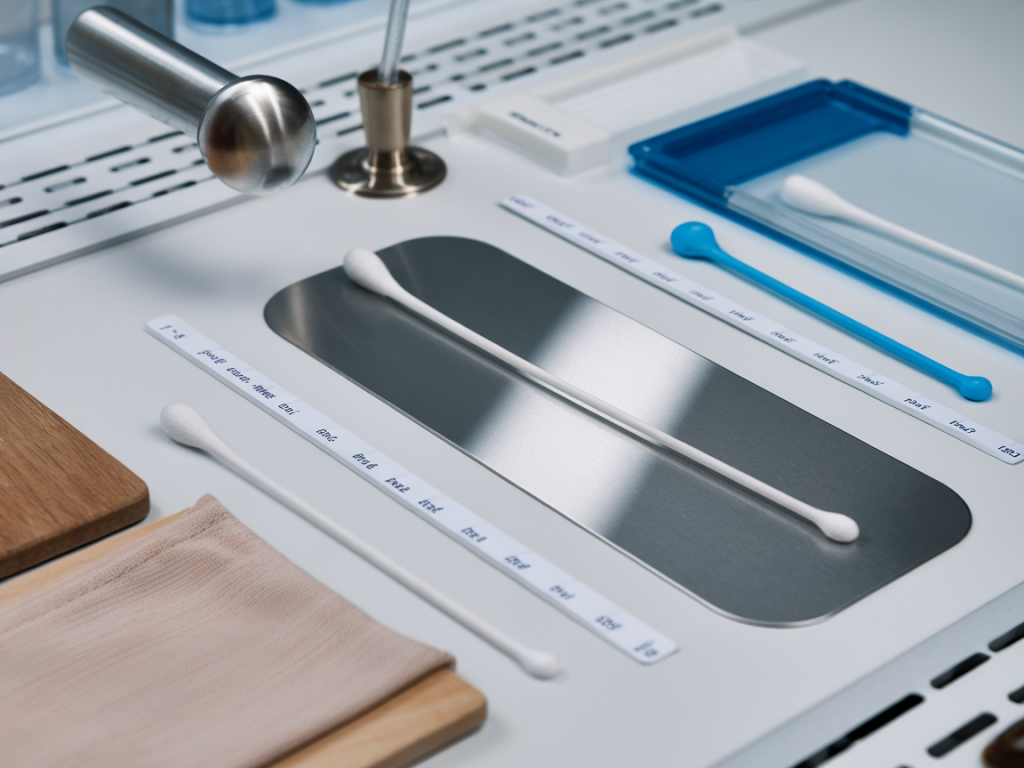
  • Sampling methods: use contact plates or swabs for culture (CFU/cm2) and ATP bioluminescence for immediate operational checks (RLU).
  • Data analysis: interpret culture results against pre-defined pass/fail thresholds; use ATP to monitor cleaning consistency and train staff.
  • Sampling protocol I use in the field

    Consistency is crucial. I standardise swab area, operator technique and timing. My usual approach:

  • Swab area: 25 cm2 (5x5 cm) template or use RODAC contact plates for flat surfaces.
  • Swab technique: apply consistent pressure and pattern (S-shape horizontally, then vertically), rotating swab tip.
  • Timing: sample immediately before cleaning, immediately after cleaning (once surface visibly dry), and 1–2 hours after reopening to traffic.
  • Replicates: minimum three samples per touchpoint type per site visit to account for variability.
  • Objective pass/fail microbiology criteria

    Below is a pragmatic set of criteria I adopt. These balance regulatory expectations, published guidance and what’s achievable in operational settings. Use culture (CFU/cm2) for formal acceptance; ATP thresholds are operational and should be correlated with culture at first implementation.

    Touchpoint type Culture pass threshold (CFU/cm2) ATP operational threshold (RLU) Notes
    Hand-contact high-touch surfaces < 5 CFU/cm2 < 250 RLU Typical office/retail public areas. Aim for ≤5 CFU/cm2 to show effective disinfection.
    Food-contact surfaces < 2 CFU/cm2 < 100 RLU Lower threshold because of ingestion risk. For ready-to-eat areas use stricter control and verify absence of Enterobacteriaceae in most samples.
    Sanitary/wet-room surfaces < 10 CFU/cm2 < 500 RLU Higher baseline due to moisture and organic load; target reduction from baseline matters as much as absolute counts.
    Clinical/critical surfaces < 1 CFU/cm2 < 50 RLU For healthcare or clinical-equivalent environments. Consider pathogen-specific testing (MRSA, VRE) and more frequent verification.
    Shared electronics & controls < 5 CFU/cm2 < 200 RLU Surfaces with complex textures; contact plates may under-sample — use swabs and accept small variability.

    Interpreting results and taking action

    If culture results exceed the pass threshold, treat it as a fail and investigate. Typical corrective actions include:

  • Check dwell time and application method — many products need a wet contact time to be effective. I’ve seen teams wipe too soon with microfibre and reduce efficacy.
  • Re-evaluate pre-cleaning — heavy organic soils inhibit disinfectants. A two-stage approach (detergent then disinfectant) is sometimes necessary.
  • Confirm product concentration — dilution errors are common when using concentrates.
  • Review training and SOPs — standardise cloths, change frequency, and wiping direction.
  • Practical tips from the field

    Some lessons I regularly share with clients:

  • Correlate ATP with culture during the first 50–100 samples so you can rely on ATP for day-to-day monitoring.
  • Use glove-change and glove hygiene protocols during sampling to avoid cross-contamination.
  • Label samples clearly with location, time, operator and environmental notes (e.g., high traffic at lunchtime).
  • When comparing products, run side-by-side samples over several days and on multiple surface types — one-off tests can be misleading.
  • Document everything. Auditors want to see SOPs, training logs, sampling records and corrective actions.
  • If you’d like, I can provide downloadable templates for sampling logs, SOP checklists and an Excel sheet that automatically flags fails based on the thresholds above. At Bluebaycleaning Co (https://www.bluebaycleaning.co.uk) I use these methods whenever we introduce a new fragrance-free product — they’re straightforward for teams to adopt and give clear evidence for procurement and compliance conversations.
    You should also check the following news:

    How to design a 21-day occupancy-driven cleaning pilot using cheap sensors to cut night shifts by 30%
    Case Studies

    How to design a 21-day occupancy-driven cleaning pilot using cheap sensors to cut night shifts by 30%

    I ran a 21-day occupancy-driven cleaning pilot at one of our mid-sized office sites to test a...

    How to train night cleaners on lone-worker safety with a 90-minute practical kit and measurable compliance checkpoints
    Health & Safety

    How to train night cleaners on lone-worker safety with a 90-minute practical kit and measurable compliance checkpoints

    Training night cleaners on lone-worker safety doesn’t have to be a dry, compliance-only exercise....