Reception areas in healthcare sites carry a particular kind of pressure. They need to feel calm, clean, and trustworthy from the moment a patient walks in, yet they are also exposed to constant footfall, anxious visitors, staff movement, deliveries, and spillages. In my experience, complaint levels in these spaces rarely come from a single issue. They usually come from a pattern: a sharp scent, a dusty surface, a sticky chair arm, a floor that feels slightly damp, or a product residue that makes people uneasy. When I look at low-allergen cleaning changes that reduce complaints most effectively, I focus on practical adjustments that lower irritation, improve consistency, and remove the small triggers that people notice immediately.
What matters most is not simply using a milder product. It is building a cleaning routine that reduces airborne irritation, avoids heavy fragrance, leaves fewer residues, and keeps surfaces visibly and physically clean without disrupting the flow of the area. In a reception space, people judge cleanliness in seconds. If they sneeze, smell a strong chemical scent, or see a cloudy film on a counter, they often assume standards are poor even if the area has just been cleaned. That is why the most effective changes are usually those that reduce sensory complaints as much as hygiene complaints.
Fragrance reduction usually makes the fastest difference
If I had to name the change that tends to reduce complaints fastest, I would start with fragrance control. Strong perfume in cleaners is still common in some buildings, but in healthcare settings it often creates more problems than it solves. Reception areas have a wide mix of users: patients with asthma, older visitors, children, pregnant women, and staff who may be exposed for long shifts. A heavy scent can be read as freshness by one person and as irritation by another. I have seen complaints fall simply by switching from scented sprays and floor cleaners to low-fragrance or fragrance-free products.
This is not just about preference. Fragrance compounds can linger in enclosed spaces and create a sense that the area has been “over cleaned” or chemically treated. In practical terms, I usually recommend fragrance-free multipurpose wipes or diluted neutral cleaners for touchpoints, then checking whether any deodorising habit is actually needed at all. In many reception areas, once waste is removed promptly and fabrics are maintained properly, the need for added scent disappears.
Residual film causes more complaints than many managers expect
One of the most common hidden causes of complaints is residue. A reception desk may look polished, but if a cleaner leaves behind a tacky film on laminate, glass, or stainless steel, people notice when they touch it. That “unclean” feeling often gets reported as a smell issue, a hygiene issue, or even a comfort issue. In reality, it may be a product misuse issue.
I have found that switching to low-allergen cleaning products with clear dilution control and low residue performance makes a noticeable difference. Neutral pH cleaners used correctly can clean surfaces without leaving a strong smell or visible build-up. Microfibre cloths also help because they lift soil effectively with less product. When I train teams, I stress that more chemical does not mean more cleanliness. In reception spaces, excessive product use is often what creates the complaint in the first place.
Microfibre systems reduce airborne irritation and improve consistency
For low-allergen cleaning, I place a lot of value on microfibre. It is one of the simplest changes, yet it can have a real effect on complaint rates. Properly maintained microfibre captures dust and fine particles instead of pushing them around. That matters in reception areas where air movement, door opening, and foot traffic can keep particles suspended.
I prefer colour-coded cloths and mops because they make the process clearer for staff and reduce cross-contamination. In healthcare receptions, I usually separate touchpoint cloths from general surface cloths and keep a strict laundering routine. A cloth that is overloaded with product or not washed properly can become part of the problem. Clean microfibre, used with a light-touch method, lowers the chance of irritation while improving the finish on desks, chairs, glass partitions, and door handles.
Vacuuming and dust control matter more than many people realise
Reception complaints are often linked to visible dust on skirting, seating, ledges, vents, and display areas. Even when the floor is clean, dust build-up makes a reception feel neglected. In healthcare sites, dust control also matters because dust can carry allergens and can become noticeable very quickly under bright lighting.
I find that regular vacuuming with a machine fitted with a HEPA filter is one of the most effective low-allergen changes. It reduces fine particle release during cleaning and helps maintain a cleaner feel between service visits. Soft furnishings need attention too. Upholstered visitor chairs, waiting benches, and fabric panels can harbour dust and skin flakes that contribute to complaints from sensitive visitors. When these items are included in the schedule, the whole area feels fresher with less product use.
Useful low-allergen dust control changes include:
Touchpoint cleaning should be simple, fast, and predictable
Reception complaints often come from the places people touch most: counters, sign-in screens, pens, card readers, lift buttons, door handles, and chair arms. If these areas feel greasy, sticky, or smudged, visitors assume the site is not well managed. For healthcare environments, I usually recommend a simple touchpoint approach with low-allergen products that dry quickly and do not leave a noticeable odour.
When I am reviewing a cleaning routine, I like to see consistency more than complexity. A clean that happens often enough, with the same method each time, does more for public confidence than a sporadic deep clean with strong chemicals. Quick-drying, low-residue wipes or diluted neutral cleaners can support frequent touchpoint cleaning without leaving the reception smelling heavily treated. That matters because many complaints are driven by perception as much as by actual dirt.
Floor care influences smell, dust, and comfort at once
Floors in reception areas absorb a huge amount of attention. They reflect light, carry footfall noise, and often hold the first visible signs of poor cleaning. Yet floor products can also create irritation if they are too strong or leave a film that traps dirt. This is why I often move healthcare reception areas toward low-allergen floor care products with controlled dilution, low scent, and reliable drying times.
For hard floors, I usually prefer a neutral cleaner that does not over-foam and does not leave a slippery finish. For entrance mats, I focus on extraction, vacuuming, and contamination control rather than scented masking products. If a floor smells strongly of product after cleaning, I see that as a warning sign rather than a sign of quality. In a healthcare reception, people need confidence, not perfume.
Staff habits have as much impact as product choice
Even the right product will fail if staff use it poorly. In my own work, I have seen complaints drop after a small amount of retraining rather than a full product change. Staff need to understand when to use damp wiping, how much solution to apply, how long a surface needs to dry, and why overuse creates issues. They also need clear instructions on disposal, cloth hygiene, and spill response.
The most useful training points I give teams are simple:
When staff understand the reason behind the method, they are more likely to keep it consistent. That consistency is what visitors notice.
Products should be chosen for both sensitivity and operational reality
I do not choose low-allergen products only because they are gentle. I also ask whether they fit the pace of the site. A reception area in a busy healthcare facility needs products that are easy to stock, easy to dilute, and reliable under pressure. I look for straightforward labelling, strong safety data, and performance that holds up when the area is busy.
Brands can vary, but the product type matters more than the logo. In some sites I have used fragrance-free neutral cleaners from established commercial ranges, low-odour disinfectant wipes where required by local protocols, and HEPA-filter vacuums for dust control. I also favour products with clear COSHH information so staff know exactly what they are handling. If a product causes uncertainty, misuse is more likely, and misuse often leads to complaints.
Which changes reduce complaints most effectively in real reception areas
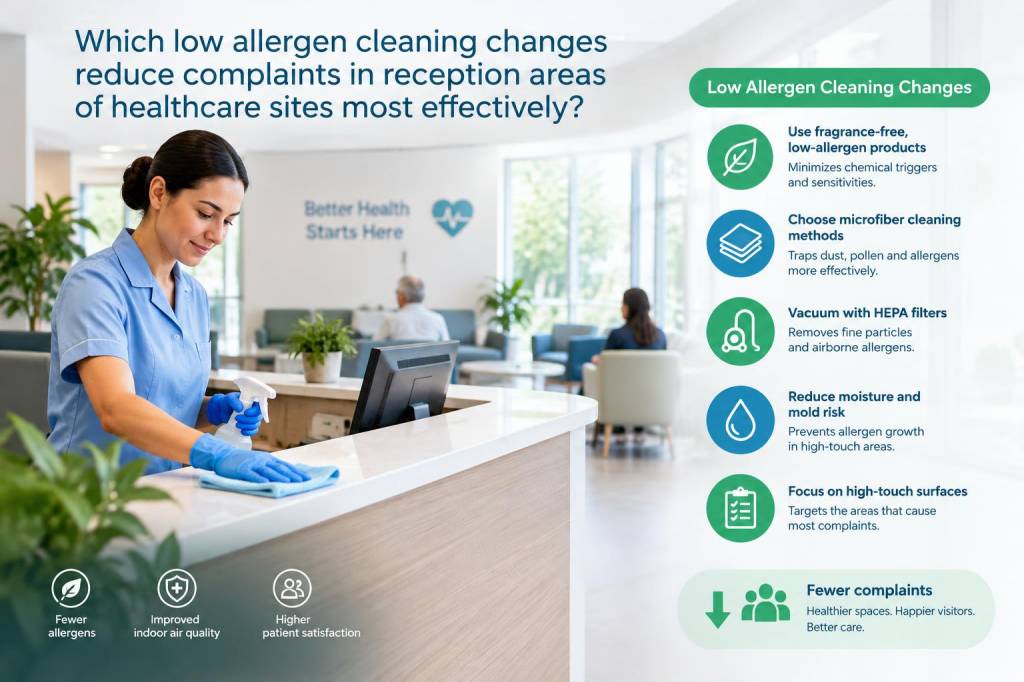
From what I have seen, the most effective low-allergen changes are the ones that remove the strongest complaint triggers first. That usually means eliminating heavy fragrance, reducing residue, improving dust control, and tightening touchpoint routines. A single change can help, but the strongest results usually come from combining a few simple adjustments rather than chasing a miracle product.
| Change | Complaint reduction effect | Why it works |
|---|---|---|
| Fragrance-free cleaning products | High | Reduces scent-related irritation and improves comfort for sensitive visitors |
| Microfibre cleaning methods | High | Lifts dust and soil with less product and less airborne spread |
| HEPA-filter vacuuming | High | Controls fine particles that trigger dust and allergy complaints |
| Low-residue neutral cleaners | Medium to high | Leaves surfaces dry, clean-feeling, and less sticky or shiny |
| Staff retraining on dilution and application | High | Prevents product overload and inconsistent results |
| More frequent touchpoint cleaning | Medium | Keeps visible and tactile contamination under control |
When I prioritise these changes, I usually start with fragrance-free products and dust control, then I check residue, then I refine staff technique. That sequence often gives the quickest reduction in complaints because it tackles what people feel, smell, and see first.
Measurement matters if you want fewer complaints, not just cleaner surfaces
I always recommend tracking complaint patterns rather than relying on gut feeling. If visitors keep mentioning odours, I want to know when they appear, which products were used, and whether the issue is linked to a certain area or time of day. If the complaint is about dust, I want to know whether vacuuming frequency, filter quality, or cloth hygiene needs attention. Without measurement, the same issue can repeat for months.
A simple record can show whether a change is working. I often review notes on:
That kind of monitoring turns cleaning from a routine task into a managed service. In healthcare reception areas, that shift is often what separates an acceptable environment from one that feels genuinely reassuring to visitors.